Your First Fun Run: A Calm Plan for the Morning
A first fun run morning plan helps you choose a meeting point, pack familiar kit, and leave enough room for the small surprises of an informal event.
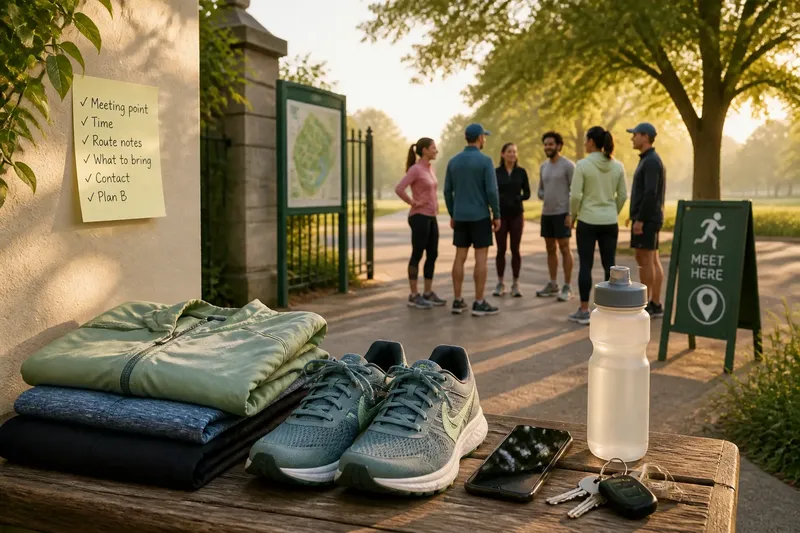
Your first fun run morning plan starts the night before, when your shoes are by the door and you know where to meet your friend. The event may be a neighborhood group jog, a charity gathering, or a casual run organized by a local club. None needs the choreography of a race, but a few small decisions can make the morning feel easier.
Think of the plan as a choice between three approaches: arrive independently, meet one person, or join a group at a shared starting spot. Each has its own trade-offs. The right one depends on how well you know the area, how much company you want, and whether you prefer to keep your morning flexible.
What should you sort out the night before?
Keep preparation small and visible. Lay out the clothes you already expect to wear, including socks and a weather-appropriate outer layer. Put your usual running shoes beside them. If you use a phone, keys, or a transit card, decide where each will go before you leave rather than searching for pockets at the door.
A simple checklist can keep little tasks from crowding your thoughts:
- Check the organizer’s message for the meeting location, start time, route notes, and any change to the plan.
- Choose clothes and shoes you already know are comfortable for an easy run.
- Set aside a small bag or pocket for keys, phone, and any essential personal item.
- Bring water if you expect to want it, and learn whether a refill point is available.
- Decide how you will get there and what you will do if your first route is delayed.
- Save a contact number or message thread so you can tell your group if you are running late.
- Choose a clear fallback meeting spot in case the starting area is busy or hard to identify.
Use the list as a prompt, not a packing contest. There is no need to buy special gear for an informal outing. Follow the organizer’s directions and the instructions on any kit you rely on; local access rules can also affect where you may wait or leave belongings.
Leave the bag you actually need by the door. A visible, modest setup is easier to remember than a last-minute pile.
Which arrival plan suits you best?
There is no single correct way to arrive. Compare the options before deciding, especially if you are new to the group or unfamiliar with the area. The best plan is the one that lets you find the start without making the whole morning depend on a fragile chain of timing.
Should you arrive on your own?
Arriving independently suits someone who knows the location, likes a quiet lead-in, or wants the freedom to leave at their own pace. It also keeps the plan simple if friends are coming from different parts of town. The trade-off is that you are responsible for spotting the group and handling any delay without a companion.
Choose this option when the start point is easy to recognize and you can check the organizer’s updates. A sign, park entrance, or named café can be more useful than an imprecise instruction such as “near the green.”
Is meeting one person the easiest choice?
Meeting a friend or host can make the arrival feel less uncertain, particularly if you have not visited the start point before. Agree on a specific landmark and a reasonable wait plan. “At the north gate by the noticeboard” gives you both more to work with than “somewhere in the park.”
This approach suits someone who wants company but does not need a large group to feel settled. It works best when each person knows what to do if the other is delayed, such as sending a message and going to the shared start area.
When does a shared group meeting point work well?
A group meeting point suits runners who want to arrive together or who are unsure where the route begins. A café patio, community hall entrance, or named park gate can give everyone a recognizable anchor. Ask the organizer how to identify the group and whether late arrivals should wait or go directly to the start.
The trade-off is that a larger gathering can be harder to spot and may not move on everyone’s preferred schedule. If you feel overwhelmed by crowds, meet a familiar person nearby first, then approach the group together.
How do you choose between the three?
Ask yourself two questions: Can I find the start without help, and would company make the first few minutes more comfortable? If you know the area and enjoy arriving quietly, go independently. If you want reassurance, arrange one clear meeting point; if several people are coordinating, use the organizer’s shared location and a fallback plan.
Say you have found a neighborhood run in a park you rarely visit and a friend is attending too. You could agree to meet by the park’s main entrance, message if either of you is delayed, and walk to the group together; the expected result is a clear arrival plan without needing to track down every runner.
How do you make a meeting point unmistakable?
A useful meeting point is specific, visible, and easy to describe in a short message. Choose a fixed feature: the entrance with the map board, a particular bridge, or the front door of a named building. Avoid a point that shifts, such as “wherever the group has set up,” unless the organizer has given a clear way to identify them.
It helps to separate the meeting place from the actual start. People may gather, greet one another, and sort their belongings before moving to the route. Confirm whether the group plans to depart from the same spot or walk to a nearby trail entrance.
Agree on a fallback that does not create confusion. For example, if the main entrance is crowded, you might meet beside the park map board. Keep the backup close enough to make sense and tell the other person about it beforehand.
If you are coordinating a group, send one concise message with the location, a recognizable landmark, the expected arrival window, and what late arrivals should do. A clear message is kinder than repeated updates that leave everyone guessing.
What belongs in your bag, and what can stay home?
For an informal run, bring only what supports your ordinary outing. A phone can help with directions or contacting a friend; keys need a secure pocket; a light layer may be useful if the weather calls for it. If you usually carry water, keep doing so. There is no need to copy another runner’s setup.
Think about where belongings will be while you run. Some gatherings have a place to leave a bag, while others do not. Ask rather than assuming, and keep valuables with you if there is no secure arrangement. A small waist belt or zippered pocket can help, but only if it is familiar and comfortable.
Leave new shoes, unfamiliar accessories, and last-minute experiments at home. An informal event is a friendly setting, but it is still easier to enjoy the run when your clothes and carry setup are things you already understand.
Pack for the outing you agreed to, not for every possible version of it.
How can you keep the morning unhurried?
Give yourself a little breathing room between getting ready and setting off. That can mean eating your usual breakfast, taking the route you already know, or allowing time to find the entrance. Do not turn a casual gathering into a schedule that leaves no room for a slow bus or a locked gate.
When you arrive, look for the organizer or a familiar face and say hello. If you are unsure about pace or distance, ask plainly before the group leaves. A useful question is, “Is this an easy conversational run, and where does the route finish?” You do not need to know every detail, but knowing the broad plan helps you decide whether it suits you.
Keep your own comfort in view. You can join the group for the warm-up, run part of the route, or head home if the outing is not working for you. Let someone know before separating, especially if you are on a route you do not know.
What if the plan changes?
Informal events can shift because of weather, a crowded entrance, or an organizer’s message. Check for updates before leaving, then keep a simple alternative in mind: wait at the agreed landmark, contact your host, or skip the run if you cannot confirm where the group is. That is enough; there is no need to improvise a route with strangers if you feel uncertain.
If you arrive after the group has started, use the organizer’s stated plan rather than trying to catch up by guessing. You might join at a named point or arrange to meet them at the finish. If no such plan exists, a relaxed solo outing another day is a reasonable choice.
A first fun run morning plan does not need to remove every unknown. It only needs to make the next decision clear: where to go, who to contact, and what to do if the group is not there. Once those pieces are settled, you can spend less of the morning looking at your phone and more of it noticing the people, place, and easy rhythm around you.