Why a Loop Can Feel Different from an Out-and-Back
A running route’s shape changes how landmarks arrive and return, helping familiar distances feel fresh without changing the ground beneath your feet.

A running route can pass the same park gate twice and still feel unlike itself. On a loop, you might meet the gate early, leave it behind, then approach it from the other side near the end. On an out-and-back, the gate marks a point you’ll revisit in reverse. That change in order is why a loop can feel different from an out-and-back, even when both cover familiar ground.
Route shape does more than draw a line on a map. It gives a run a sequence: what appears first, what stays ahead, and what comes into view again. Once you notice that sequence, choosing between a loop and an out-and-back becomes a way to choose the kind of attention your run invites.
What changes when the route turns around?
An out-and-back has a clear hinge. You travel away from a starting point, reach a turnaround, and retrace your path. The return leg repeats the same streets or trail, but your viewpoint has changed. A hill that seemed to pull you forward is now behind you; a row of trees you saw in the distance comes closer from the opposite direction.
A loop has no single hinge. It returns you to the start by a different line, so the scenery keeps changing. Even when a loop crosses a familiar stretch, the approach may be different. A bridge can appear after a quiet residential street in one direction and after an open field in the other.
The difference is not simply “same scenery” versus “new scenery.” The out-and-back offers a repeated sequence viewed backward. The loop offers a sequence that continues to unfold, with the finish connected to the beginning.
Why does landmark order matter?
Runners often remember routes through landmarks rather than through a list of turns: the red footbridge, the corner shop, a bend beneath tall trees. Those landmarks act like informal punctuation. They divide a run into recognizable passages and give the mind something to anticipate.
On an out-and-back, a landmark has two roles. First it signals progress away from home; later it signals the approach toward home. The same object can feel like a destination on the way out and a reassurance on the way back. That reversal gives a familiar route a small narrative arc.
On a loop, landmarks tend to arrive once, in a particular order. A playground may be followed by a shaded path, then an open stretch beside a creek. Because the sequence does not repeat in reverse, each new scene can reset your attention. The route may feel more varied even if the distance and effort are much like another run.
Pay attention to what you see first. That opening landmark can set the tone for the entire route.
How do the two shapes affect anticipation?
An out-and-back makes the turnaround easy to imagine. You know there is a point where the route changes direction, even if you choose that point by feel rather than by a sign. The return is also visible in your memory. That can make the run feel straightforward: go out, turn, come home.
A loop creates a different kind of anticipation. You may know the general route but not have a single moment that announces, “Now the return begins.” Instead, the sense of coming home gathers gradually as familiar streets or park edges appear. The finish may feel like a destination reached by discovery rather than retracing.
Neither pattern is automatically easier or more enjoyable. A runner who likes knowing what lies ahead may prefer a clear turnaround. Someone who enjoys changing scenery may like the unfolding quality of a loop. Mood matters, too: a repeated route can be comforting on a busy day, while a different sequence can help a routine feel less automatic.
How can you choose a route for the run you want?
Start with the experience you want, not just the shape on the map. If you want a recognizable midpoint and a familiar return, an out-and-back offers that structure. If you want the scenery to keep changing, look for a loop with distinct sections rather than one that circles the same block.
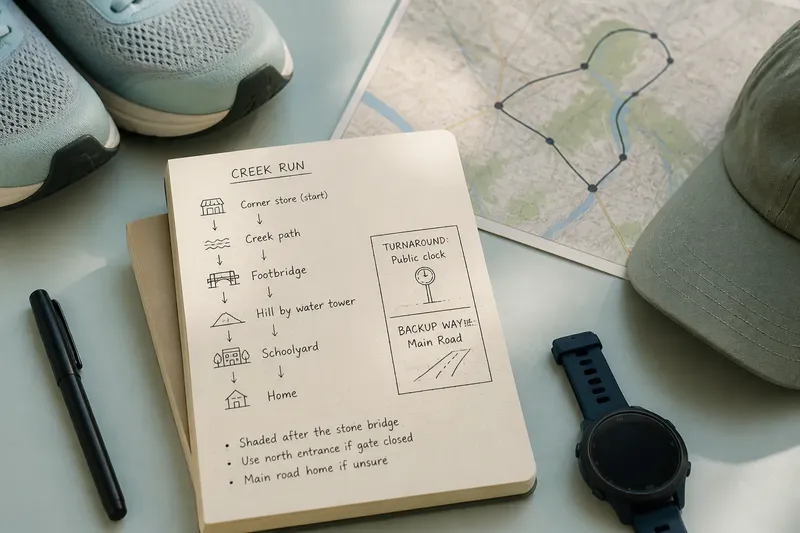
Say you have a familiar park path and a neighborhood street that connects to it. Imagine choosing the park gate as the first landmark, crossing the footbridge next, and finishing through the neighborhood. If you reverse the same streets as an out-and-back, the bridge becomes the turning point and the gate returns near the end. The ground is familiar, but the order gives each version a different rhythm.
Before setting out, consider practical route details that shape how the sequence feels:
- Landmark spacing: Notice whether recognizable places arrive close together or leave long stretches without a clear visual marker.
- Viewpoint: Check whether a hill, bridge, or waterfront looks different from the opposite direction.
- Route continuity: For a loop, look for a clear connection back toward the start rather than an awkward detour at the end.
- Surface changes: Notice where pavement gives way to gravel or a path narrows, since those transitions can stand out more in one direction.
- Crossings and access: Choose a route whose street crossings, gates, and open paths suit the time and conditions of your run.
For details that depend on local access, posted signs, or route conditions, follow the relevant guidance and adapt your choice. A pleasant sequence is only useful if the route is open and comfortable to use.
What do runners often ask about route shape?
Is an out-and-back always easier to remember?
It often has a simple structure because the turnaround divides the run into two clear parts. A loop can be easy to remember too, especially when its landmarks arrive in a distinct order.
Can a loop and an out-and-back cover the same distance?
They can, depending on the available paths and where the route begins and ends. The shape changes how the scenery unfolds, not necessarily how much ground you cover.
Why does the same path look different in reverse?
Your direction changes which features lead your gaze and which ones appear behind you. A slope, building, or line of trees can seem more prominent when it becomes the approach rather than the departure.
Which route shape is better for a familiar run?
Choose based on what you want to notice. An out-and-back revisits landmarks in reverse, while a loop can place familiar scenery in a new order.
How can a familiar route keep its character?
Try changing direction before replacing the route entirely. A loop run clockwise may place a quiet lane at the beginning; running it the other way may make that lane the final stretch. You can also notice one landmark you usually pass without thought and see what comes immediately before and after it.
This is a small way to make a regular running route feel distinct without asking it to become a different route. The map may stay the same, but your attention follows a new sequence. A loop and an out-and-back are not merely two ways to connect start and finish; they are two ways to arrange what a run lets you see, remember, and look forward to.
Next time you head out, choose one landmark to watch for and notice whether it greets you, guides you, or brings you home.